

Most people believe a simple last will and testament is the ultimate safeguard for their family’s future, but in 2026, relying solely on one could actually invite the very legal delays and costs you’re trying to avoid. While a will provides a clear roadmap for the courts, it doesn’t offer the privacy or immediate asset transition that many Maryland families require to maintain stability. Understanding the nuances of a trust fund vs will is essential when your goal is to minimize the reach of the Register of Wills. You’ve worked hard to build your legacy, and it’s natural to feel anxious about the state’s unique tax landscape or the prospect of your private affairs becoming public record through a lengthy probate process.
This guide clarifies the critical differences between these estate planning tools to help you determine which strategy secures your assets and protects your loved ones from unnecessary state intervention. You’ll discover how the $5 million Maryland estate tax threshold affects your planning and why a trust might be the more efficient vehicle to bypass the 10% inheritance tax for certain heirs. We’ll provide a methodical look at both options so you can move forward with a plan that prioritizes precision, minimizes tax liabilities, and ensures your family remains protected during complex transitions.
Key Takeaways
- Identify the fundamental differences between a will, which acts as a public instruction for the court, and a trust, which provides a private mechanism for immediate asset management.
- Learn how to navigate the Maryland probate process to protect your family’s privacy and avoid the administrative costs associated with court-supervised distributions.
- Explore how specific trust structures can offer robust protection against future creditors and assist with long-term Medicaid planning for your family home.
- Determine whether a trust fund vs will is the most appropriate strategy based on the complexity of your assets and your specific goals for 2026.
- Understand the essential process of funding your trust to ensure it functions as intended and remains aligned with evolving state and federal tax regulations.
Understanding the Core Differences: Trust Fund vs. Will
Choosing the most effective path for your estate requires a clear grasp of how different legal instruments function under Maryland law. At its simplest level, the debate of a trust fund vs will comes down to timing and control. A last will and testament is a static document. It serves as a set of instructions that only carries legal weight after you pass away. Until that moment, it grants no authority over your assets and provides no protection if you become incapacitated.
A trust operates on an entirely different timeline. It is a dynamic fiduciary arrangement that allows for the management of assets while you are still alive. This “living” quality is why many Bethesda families prefer trusts for long-term security. While a will is a letter to a court, a trust is a private contract that can govern your affairs across multiple generations.
What is a Last Will and Testament?
A will is essentially a roadmap for the probate court. You appoint an executor, also known in Maryland as a personal representative, to oversee the distribution of your belongings. This individual is responsible for paying final debts, filing tax returns, and ensuring beneficiaries receive their intended portions. However, this process is not private. Once a will enters probate, it becomes a matter of public record at the Register of Wills, meaning anyone can view the details of your legacy.
Wills also face inherent limitations in their scope. They are effective for simple distributions but lack the mechanism to manage assets over an extended period. If you wish to stagger an inheritance for a younger relative or provide for a loved one with special needs, a will alone often lacks the necessary structure to provide ongoing oversight.
What is a Living Trust?
To understand the advantages of this strategy, one must first ask: What is a Trust? In legal terms, it is an arrangement where a grantor transfers ownership of assets to a trustee. This trustee holds and manages those assets for the benefit of a third party, the beneficiary. During your lifetime, you may serve as all three roles, maintaining total control while ensuring a seamless transition if you are no longer able to manage your affairs.
When comparing a trust fund vs will, the “fund” itself refers to the specific assets, such as real estate, investment accounts, or business interests, that you have legally moved into the trust’s name. This structure offers several distinct benefits:
- Privacy: Because the trust operates outside of the court’s jurisdiction, your family’s financial details remain confidential.
- Flexibility: You can choose between a revocable trust, which you can change at any time, or an irrevocable trust, which offers enhanced tax and creditor protections.
- Continuity: There is no “gap” in management. Your successor trustee steps in immediately without waiting for court approval.
The Public Cost of Privacy: Why Maryland Probate Matters
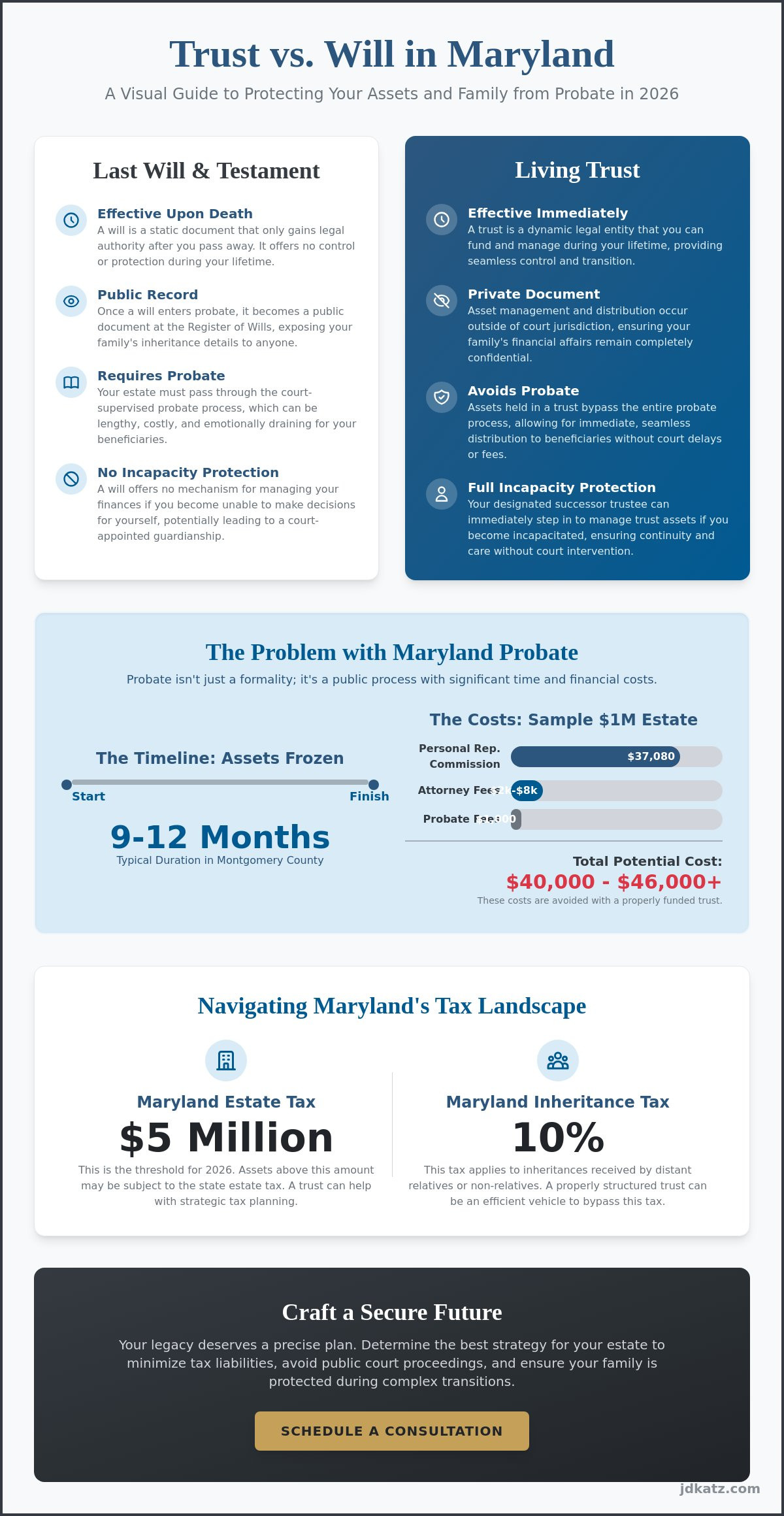
Maryland probate isn’t just a legal formality; it’s a public, court-supervised process that can consume significant time and resources. When evaluating a trust fund vs will, the most immediate difference is how each interacts with the Maryland Register of Wills. A will must pass through probate to be validated, a process that typically spans nine to twelve months in Montgomery County. During this period, assets are often frozen, requiring court approval before they can be distributed to your heirs.
The financial impact of this process is measurable. For estates opened on or after October 1, 2022, probate fees are tiered based on the gross estate value. An estate valued at $1 million incurs a $1,000 fee, while those over $10 million face a $10,000 base fee plus 0.02% of the excess. Beyond court fees, personal representatives may claim commissions of up to 9% on the first $20,000 and 3.6% on the remaining balance. These costs, combined with attorney fees that often range from $2,000 to $8,000, can noticeably deplete the legacy you intended for your heirs. A trust avoids these expenses by allowing for the immediate transfer of assets without court intervention.
The Burden on Your Beneficiaries
The delay in asset distribution creates more than just a financial hurdle. It places an emotional strain on beneficiaries who may need immediate access to funds for funeral expenses, mortgage payments, or ongoing bills. A trust provides this liquidity. Because it is a private agreement, a successor trustee can often begin managing and distributing funds within days of a passing. Understanding the key differences between wills and trusts helps families recognize that a trust offers the stability a will cannot provide during the initial months of mourning.
Maintaining Family Privacy
For high-net-worth families in Bethesda, privacy is often as valuable as the assets themselves. A will filed with the Register of Wills becomes a public document. This means your complete list of assets, their specific valuations, and the names of your beneficiaries are accessible to any member of the public. This transparency can unfortunately lead to unwanted solicitations or predatory inquiries during a vulnerable time. A trust keeps these details confidential, ensuring your family’s financial footprint remains out of the public eye. If you are concerned about the exposure of your estate, consulting with a professional in probate and estate administration can help you structure a plan that prioritizes discretion and protects your loved ones from public scrutiny.
Asset Protection and Control: When a Simple Will Is Not Enough
A simple will is often sufficient for straightforward asset transfers, but it lacks the sophisticated mechanisms required for true protection and long-term control. When comparing a trust fund vs will, the primary advantage of the former lies in its ability to shield your legacy from external threats. A will offers no protection against creditors or legal judgments; once assets are distributed via probate, they are immediately vulnerable to the beneficiary’s own financial liabilities. A trust, particularly an irrevocable one, creates a distinct legal entity that can hold assets beyond the reach of lawsuits or business failures.
This level of oversight is not reserved exclusively for the ultra-wealthy. Families with modest estates often find that the advantages of a trust are essential for managing life’s unpredictable transitions. By establishing specific conditions for how and when funds are released, you ensure that your hard-earned assets aren’t depleted by a beneficiary’s lack of financial experience or temporary personal setbacks. It’s a proactive approach that prioritizes the long-term stability of your heirs over the immediate convenience of a one-time distribution.
Medicaid Planning and Long-Term Care
One of the most significant gaps in traditional estate planning is the failure to account for the rising costs of long-term care. In Maryland, the “look-back” period for Medicaid eligibility is five years. This means any assets transferred out of your name within sixty months of applying for benefits could trigger a penalty period. By utilizing an irrevocable trust as part of a comprehensive Medicaid Planning strategy, you can protect the equity in your family home while still qualifying for necessary care. Starting this process early is vital to ensuring your residence remains an inheritance for your children rather than a resource consumed by nursing home costs.
Providing for Minors and Special Needs
A will typically mandates an immediate distribution of assets once the probate process concludes. For a young adult or a child, receiving a sudden windfall can be overwhelming. Trusts allow you to stagger distributions based on age or milestones, such as graduating from college or reaching age thirty. This structure also proves critical for families supporting individuals with disabilities. A Special Needs Trust (SNT) allows a beneficiary to receive supplemental funds without jeopardizing their eligibility for essential government benefits like SSI or Medicaid. Additionally, assets held within a trust are generally protected from a child’s potential divorce, ensuring your legacy stays within the family as you intended.
Choosing the Right Strategy for Your Bethesda Estate
Determining the right path isn’t a matter of hitting a specific dollar amount; it’s a matter of evaluating the intricacies of your life. When weighing a trust fund vs will, you must consider whether your goals are simply to distribute property or to manage a complex transition. A trust requires an upfront investment of time and resources to “fund” it. This process involves retitling assets like bank accounts, investment portfolios, or real estate into the name of the trust. Without this meticulous step, the trust remains an empty vessel, and those assets will still be subject to the very probate process you intended to avoid.
Most comprehensive plans in Bethesda utilize a “Pour-Over Will” alongside a trust. This document acts as a legal safety net, ensuring any assets accidentally left out of the trust are “poured” into it upon your death. When considering the total cost of a trust fund vs will, it’s helpful to view the trust as a proactive investment in your family’s future stability. While the initial creation involves higher legal costs than a simple will, the long-term savings in probate fees and personal representative commissions often make it the more economical choice for many families.
When a Will May Be Sufficient
A will might be the appropriate choice if your estate is relatively small and your asset structure is simple. If you utilize beneficiary designations, such as Payable on Death (POD) or Transfer on Death (TOD) accounts, you can move significant liquid assets outside of probate without a trust. This strategy works well for individuals with straightforward heirs and few physical properties. Crucially, a will remains the only legal document where you can name guardians for your minor children, a step that is non-negotiable for young parents in Bethesda.
When a Trust is Essential
A trust becomes a strategic necessity in several specific scenarios that a will cannot adequately address. These situations often involve:
- Multi-State Property: If you own real estate in another state, a trust prevents your family from having to open multiple probate cases in different jurisdictions.
- Blended Families: Trusts allow you to provide for a current spouse while ensuring children from a previous relationship remain the ultimate beneficiaries.
- Business Continuity: For entrepreneurs, a trust ensures a seamless transition of control, preventing a business from stalling while the court validates a will.
If you’re ready to build a framework that accounts for these variables, you can start by exploring our specialized approach to wills and trusts to ensure every detail of your legacy is protected.
Crafting a Secure Future with JDKatz
Effective estate planning is rarely a singular event; it’s an ongoing process of refinement and strategic adjustment. When you evaluate the merits of a trust fund vs will, you’re making a decision that impacts your family’s financial security for decades. At JDKatz, our approach is built on multi-disciplinary expertise that bridges the gap between technical tax law and personal legacy protection. We don’t simply draft documents. We act as long-term partners who integrate tax defense and business law into your estate strategy, ensuring that your plan remains resilient against shifting regulations and economic transitions.
The legal landscape in Maryland is subject to frequent updates, such as the established $5 million estate tax exemption that remains unindexed for inflation in 2026. Because of these nuances, regular reviews of your documents are essential. A plan that was perfectly structured five years ago might no longer offer the same level of protection today. By maintaining a proactive relationship with our clients, we ensure that your assets are positioned to minimize tax liabilities and avoid the administrative hurdles of the Register of Wills.
The Value of Professional Legal Counsel
While online templates and “DIY” legal forms have become more accessible, they often fail to account for the specific procedural requirements of Maryland courts. A minor error in wording or a failure to follow strict execution protocols can lead to a will being contested or a trust being deemed invalid. Our role as counsel extends beyond drafting; we guide you through the critical “funding” process to ensure your assets are correctly retitled into your trust. Local Bethesda expertise is vital for ensuring that your Montgomery County filings are handled with the precision required to avoid unnecessary court delays.
Next Steps for Your Estate Plan
Preparing for your future begins with a holistic view of your circumstances. During an initial consultation, we review your financial portfolio, business interests, and family goals to determine which tools best serve your needs. Beyond the primary decision of a trust fund vs will, a comprehensive strategy must include documents that protect you during your lifetime, such as a Power of Attorney and Healthcare Directives. These instruments provide security if you become unable to manage your own affairs, offering a complete framework of protection for you and your loved ones.
Taking the first step toward a structured legacy doesn’t have to be overwhelming. With clear guidance and a methodical approach, you can move from uncertainty toward a plan that provides lasting peace of mind. Schedule your estate planning consultation with JDKatz today to begin securing your family’s future.
Empowering Your Legacy Through Strategic Planning
We’ve explored how the choice of a trust fund vs will defines the privacy, speed, and cost of your estate’s transition. Precision matters. While a will serves as a foundational roadmap for the courts, a trust offers the immediate control and asset protection necessary to navigate Maryland’s unique $5 million estate tax threshold and complex probate fees. Balancing these tools requires a methodical look at your family’s specific financial landscape and long-term care needs.
With over 20 years of expertise in Maryland estate and tax law, our team serves as aggressive advocates for your asset protection. We provide comprehensive Medicaid and probate support to ensure your transition is managed with meticulous care. Secure your legacy with a customized Maryland estate plan from JDKatz to move forward with a strategy built on stability and foresight. You’ve worked hard for your family’s future. It’s time to protect it.
Common Questions Regarding Maryland Estate Planning
Is a trust fund better than a will for avoiding taxes in Maryland?
Neither a will nor a standard revocable trust inherently reduces the Maryland estate tax, as assets in both are included in your taxable estate. However, specific irrevocable trust structures can remove assets from your estate to stay below the $5 million Maryland exemption. This distinction is a primary factor when evaluating a trust fund vs will for tax efficiency and long term wealth preservation.
Can I have both a will and a trust at the same time?
Yes, most sophisticated estate plans utilize both a will and a trust to create a comprehensive safety net. A “pour-over will” is specifically designed to capture any assets that were not formally retitled into your trust during your lifetime. This ensures that every piece of property is eventually managed according to your trust’s private instructions rather than being distributed by the court.
How much does it cost to set up a trust vs. a will in Bethesda?
Establishing a trust generally involves a higher upfront cost than a simple will because it requires more complex drafting and the active transfer of your assets. While initial legal fees reflect this complexity, a trust typically saves your family money in the long run. By avoiding the Maryland probate process, you eliminate court filing fees and the commissions that personal representatives are entitled to claim.
Does a trust protect my assets from a nursing home?
Only an irrevocable trust provides protection against nursing home costs and Medicaid spend-down requirements. Because you must relinquish control of the assets to the trust, they are no longer counted toward your eligibility after the Maryland five-year look-back period. A revocable living trust does not offer this protection; the state views those assets as available resources because you maintain the power to use them.
What happens if I die without a will or a trust in Maryland?
If you die without a plan, your assets are distributed according to Maryland’s intestacy laws, which follow a rigid statutory formula. The state decides the portion of your estate that goes to your spouse, children, or parents, regardless of your personal relationships or verbal promises. Choosing between a trust fund vs will allows you to maintain control over these decisions and prevents the state from directing your legacy.
How often should I update my estate planning documents?
You should review your estate plan every three to five years or immediately following major life changes like a marriage, divorce, or the birth of a child. Significant shifts in your financial portfolio or changes to Maryland’s tax regulations also require a professional assessment. Regular reviews ensure that your documents remain legally sound and continue to reflect your current goals for asset distribution and protection.
Can a will be contested more easily than a trust?
Wills are generally more susceptible to legal challenges because the probate process provides a public forum for heirs to raise objections. Trusts are private documents that are not automatically subject to court proceedings, making them harder to contest. Since a trust is often active during your lifetime, it provides stronger evidence of your intent and mental capacity than a document that only becomes effective after death.
Do I need a lawyer to set up a trust fund?
Engaging a lawyer is essential to ensure your trust is valid and that your assets are correctly funded into the structure. Simple drafting errors or failures in retitling bank accounts and real estate can render a trust ineffective, leading to the very probate delays you intended to avoid. Professional counsel provides the technical precision necessary to navigate Maryland’s specific legal requirements and protect your family from future litigation.