

What if the difference between a routine civil audit and a life-altering criminal indictment rests entirely on how the IRS interprets a single “willful” mistake? It’s natural to feel a sense of profound anxiety when IRS Special Agents begin scrutinizing your financial records, especially when the line between a clerical error and a “badge of fraud” feels dangerously thin. Engaging a seasoned tax fraud attorney is often the first step toward regaining control; with the IRS maintaining an 89% conviction rate in recent prosecutions, you likely worry about the potential loss of your professional license or the impact an investigation could have on your standing in the Bethesda business community.
This article will explain how an expert-led defense can reframe these complexities, aiming to transition a high-stakes criminal investigation into a manageable civil resolution. You’ll learn how a composed strategy can address the 75% civil fraud penalty while proactively mitigating the risk of imprisonment. We will examine the specific methods used to challenge allegations of intent, the 2026 enforcement landscape, and the precise steps necessary to protect your reputation and your liberty.
Key Takeaways
- Learn to differentiate between unintentional tax errors and the “willfulness” standard the IRS must prove to secure a fraud conviction.
- Recognize the critical procedural shifts that signal a transition from a routine civil audit to a criminal inquiry.
- Discover how a tax fraud attorney utilizes the “Good Faith” defense to protect your financial standing and professional reputation.
- Evaluate the strategic pathways available to mitigate severe criminal penalties, aiming for a structured civil resolution instead.
- Understand the importance of local legal expertise when navigating the distinct procedural nuances of Maryland and DC federal courts.
Table of Contents
- Understanding the Legal Distinction Between Tax Mistakes and Tax Fraud
- The IRS Criminal Investigation (CI) Process: What to Expect
- Civil vs. Criminal Tax Fraud: Penalties and Resolution Paths
- Strategic Defense: How a Tax Attorney Challenges Allegations
- Protecting Your Future: Why Local Bethesda Counsel is Critical
Understanding the Legal Distinction Between Tax Mistakes and Tax Fraud
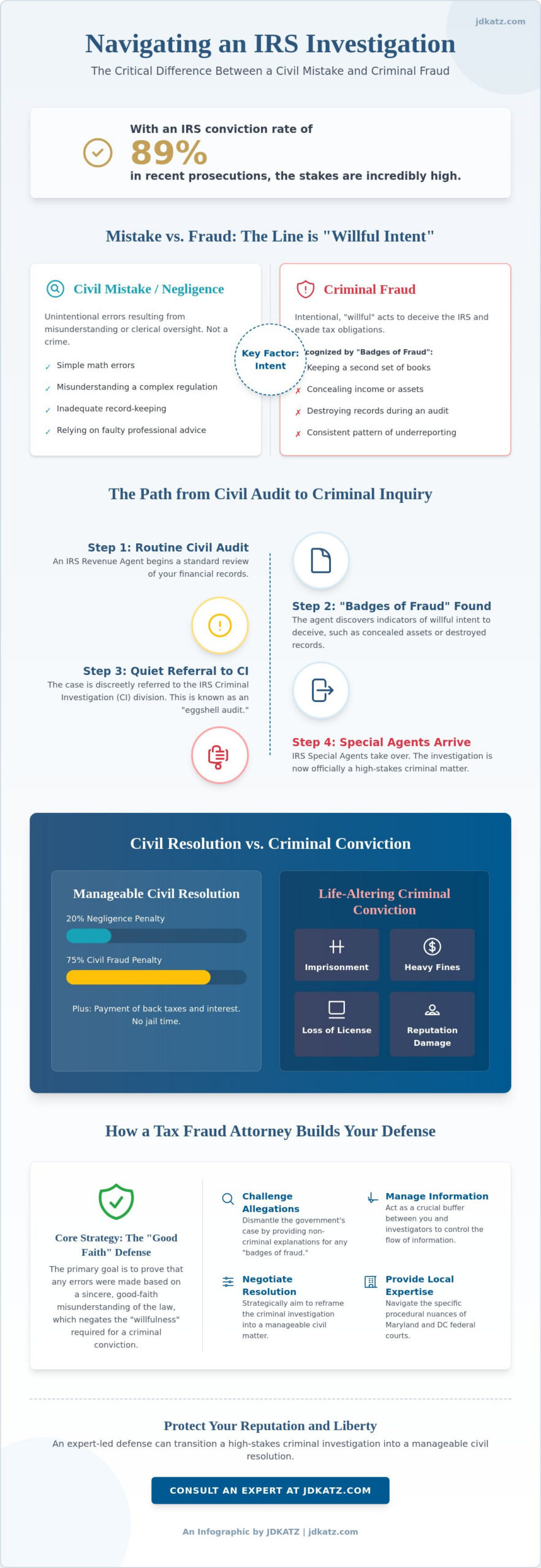
Many Bethesda business owners feel an immediate sense of dread when they receive an IRS notice, yet it’s vital to recognize the Legal Distinction Between Tax Mistakes and Tax Fraud. The IRS defines tax fraud as an intentional act designed to deprive the government of revenue. It isn’t enough for the government to show that you made an error; they must prove “willfulness.” This means you knew you had a legal obligation and you intentionally chose to ignore it. A simple math error or a deduction that the IRS later disallows because you misunderstood a complex regulation doesn’t constitute a crime. These are considered civil matters that typically result in interest and minor penalties rather than a criminal indictment.
For a local business, civil negligence might look like failing to keep adequate records for travel expenses or miscalculating the depreciation of equipment. Criminal evasion, however, involves affirmative acts like maintaining a second set of books, purposefully omitting an entire source of income, or using a false Social Security number. If you’re facing scrutiny, consulting a tax fraud attorney can help you establish that your actions lacked the necessary intent for criminal charges. Proving that an error was the result of a sincere misunderstanding of the law is a foundational element of a successful defense.
The Burden of Proof in Tax Fraud Cases
In a criminal prosecution, the government carries a heavy burden. They must prove every element of the crime beyond a reasonable doubt, which is the highest standard in the American legal system. Since direct evidence of intent is rare, the IRS often relies on circumstantial evidence. They look for specific “badges of fraud” to build their case. These indicators include things like destroying records after an audit begins, concealing assets in someone else’s name, or providing inconsistent statements to investigators. A tax fraud attorney works to dismantle these inferences by providing alternative, non-criminal explanations for these behaviors, ensuring that the government cannot meet its strict burden of proof.
Negligence vs. Fraud: Where the IRS Draws the Line
The IRS separates simple negligence from fraud based on the taxpayer’s efforts to comply. If you can show “reasonable cause,” such as relying on the advice of a qualified professional, you might avoid the 20% negligence penalty altogether. However, the IRS holds sophisticated taxpayers, such as corporate officers or high-net-worth individuals, to a higher standard of scrutiny. They assume these individuals have the resources to understand their obligations. Consistent patterns of underreporting over several years are often what tip the scales from a civil audit into a criminal investigation. It’s the difference between a one-time oversight and a calculated strategy to evade the 6% interest rate and 75% civil fraud penalty.
The IRS Criminal Investigation (CI) Process: What to Expect
A civil audit can feel routine, but it’s the most common entry point for a criminal case. When a revenue agent discovers “badges of fraud,” they don’t simply announce a problem. Instead, they quietly refer the file to the Criminal Investigation division. This creates what professionals call an “eggshell audit.” In this scenario, the taxpayer continues to provide information to a civil auditor, unaware that a Special Agent is already reviewing the file for potential prosecution. If you suspect an audit is taking a sharp turn toward your personal intent rather than just the numbers, seeking IRS tax audit representation can provide the necessary buffer between you and the government.
Understanding The IRS Criminal Investigation (CI) Process is essential for anyone facing federal scrutiny. In the Maryland and DC district, these investigations are methodical and often take years to conclude. The IRS CI initiated 2,043 investigations in fiscal year 2025 alone, focusing heavily on tax crimes. Because the IRS maintains an 89% conviction rate, the early stages of an investigation are the most critical time to involve a tax fraud attorney. These professionals manage the flow of information to ensure you don’t inadvertently provide the government with the evidence it needs to build a criminal case.
The Arrival of Special Agents
Unlike civil auditors, Special Agents are federal law enforcement officers. They carry badges and firearms. Their arrival at a Bethesda home or office usually signifies that the IRS has already gathered substantial evidence. One of the most dangerous mistakes a taxpayer can make is participating in an “informal” interview. Agents are trained to elicit admissions that can later be used as evidence in court. You aren’t required to speak to them without your legal counsel present. Remaining silent until you can consult with a tax fraud attorney is a right that protects your liberty and your future.
Grand Jury Subpoenas and Search Warrants
Federal tax cases in the Greenbelt or Baltimore courts often involve the use of grand juries. A grand jury subpoena requires the production of documents or testimony, while a search warrant allows agents to seize physical and digital records immediately. During these high-stress events, maintaining attorney-client privilege is paramount. A legal strategist ensures that the government doesn’t overstep its bounds or seize protected communications. Managing this document production with precision is often the difference between a controlled defense and a total loss of privacy.
Civil vs. Criminal Tax Fraud: Penalties and Resolution Paths
The financial and personal stakes of a tax investigation are rarely static; they escalate based on the IRS’s classification of your conduct. If the government pursues a civil resolution, the primary weapon is the civil fraud penalty under IRC § 6663, which adds 75% of the underpayment to your total bill. By contrast, a criminal conviction carries the weight of a federal prison sentence and a permanent record. Analyzing the IRS Criminal Investigation (CI) Process through official reports shows that in fiscal year 2025, the government identified $4.5 billion in tax fraud. A seasoned tax fraud attorney prioritizes steering the case toward a civil settlement, aiming to satisfy the government’s appetite for revenue without sacrificing the client’s liberty.
Beyond fines and prison, the collateral consequences of a fraud allegation can be devastating for Bethesda professionals. A criminal indictment often triggers the immediate suspension or loss of professional licenses in fields like law, medicine, or finance. Furthermore, federal law allows for the revocation of passports for taxpayers with “seriously delinquent” tax debt. In Maryland, a conviction for willfully filing a false return is considered perjury and can carry up to 10 years in state prison. Protecting your voting rights and your ability to travel requires a defense strategy that addresses these secondary risks as early as the initial audit stage.
Monetary Impact of Fraud Allegations
The financial burden of a fraud investigation extends far beyond the original tax debt. With the IRS interest rate for underpayments set at 6% per year and compounded daily as of the second quarter of 2026, the total amount owed can double in a short window. When the 75% civil fraud penalty is applied, the liability often exceeds the taxpayer’s liquid assets. This frequently leads to federal tax liens, which the IRS uses to secure its interest in your real estate or business holdings. Our approach involves a meticulous analysis of your financial exposure to determine which defense resources will most effectively protect your remaining assets from seizure.
The Threat of Incarceration
Federal prison is a stark reality for those convicted of tax evasion, with average sentences currently ranging between 40 and 44 months. Under the Federal Sentencing Guidelines, the length of a sentence is largely determined by the “Tax Loss,” which is the total amount of revenue the government claims it lost. A tax fraud attorney can challenge this calculation to reduce potential sentencing exposure. To protect your financial disclosures during this process, we often utilize a “Kovel” accountant. This specialized professional works directly under the attorney’s supervision, extending attorney-client privilege to the complex accounting work required for your defense.
Strategic Defense: How a Tax Attorney Challenges Allegations
Defending against tax evasion isn’t about denial. It’s about deconstructing the government’s case. A tax fraud attorney often starts by challenging the IRS’s calculation of the “Tax Loss.” Because federal sentencing guidelines are tied directly to the amount of revenue the government allegedly lost, reducing this figure can significantly lower the severity of the charges. We scrutinize every deduction and credit the IRS may have ignored to ensure the financial narrative is accurate and fair. This technical review is often the first step in shifting a case from a criminal felony to a civil resolution.
For individuals who recognize potential exposure before an investigation begins, the IRS Voluntary Disclosure Practice provides a structured path to compliance. By coming forward proactively, taxpayers can often avoid criminal prosecution entirely, provided the disclosure is timely and complete. If an investigation is already underway, we pivot to protecting your constitutional rights. This includes the potential suppression of evidence if Special Agents conducted illegal searches or violated your rights during an interview. If you’re concerned about how your specific financial history might be interpreted, you should consult with our team for IRS tax audit representation to begin building your defense.
Dismantling the Argument of Willfulness
Willfulness is the government’s biggest hurdle. We often counter their arguments by highlighting a consistent history of past compliance, which suggests that any current error is an isolated outlier rather than a pattern of deceit. Another powerful tool is the “Advice of Counsel” defense, which demonstrates that you relied in good faith on the guidance of a qualified tax professional. Under the “Cheek” defense, a taxpayer’s subjective, good-faith belief that they weren’t violating the law negates willfulness, even if that belief is objectively unreasonable. By documenting these subjective beliefs, we can often reframe “fraud” as a complex misunderstanding of the law.
Negotiating with the Department of Justice (DOJ)
The transition from IRS CI to the DOJ Tax Division represents a critical juncture in your defense. This stage is the final opportunity to stop an indictment before it’s filed in federal court. During a DOJ conference, a tax fraud attorney presents “declination” arguments, which are designed to show that a jury is unlikely to convict based on the available evidence. These meetings require a composed and professional presentation; they aren’t about emotion, but about the logical application of the law to the facts. A successful conference can result in the DOJ declining to prosecute, effectively ending the criminal threat and returning the matter to the civil division for a financial settlement.
Protecting Your Future: Why Local Bethesda Counsel is Critical
The Maryland and DC federal courts have unique procedural rhythms that outside firms often overlook. Whether your case is heard in Greenbelt, Baltimore, or the District of Columbia, having a tax fraud attorney who understands the specific priorities of regional prosecutors is a distinct advantage. In the close-knit Montgomery County business community, a tax investigation isn’t just a legal hurdle; it’s a profound threat to your standing and professional reputation. Discretion is paramount. Composed advocacy helps contain the narrative, ensuring that a private tax matter doesn’t become public knowledge before a defense strategy is fully implemented.
Our approach at JDKatz is built on the principle of foresight. We recognize that an IRS investigation is a high-stakes transition that requires steady, meticulous guidance. By focusing on risk mitigation and strategic planning, we aim to resolve allegations with minimal disruption to your life. This methodical pace ensures you feel informed and empowered throughout the process, reflecting a partnership that values precision over superficial, rushed interactions.
A Multidisciplinary Defense Strategy
Tax allegations don’t exist in a vacuum. They often ripple through your broader financial and legal architecture. For example, a fraud investigation can jeopardize the integrity of existing wills and trusts or complicate the governance of your business formations. If you’re a business founder, your personal tax exposure could trigger specific clauses in commercial litigation or shareholder agreements. We provide IRS Tax Audit Representation in Bethesda that considers these complex intersections, protecting your corporate interests while we defend your individual liberty. This foresight ensures that one legal challenge doesn’t dismantle years of careful estate planning and business growth.
Immediate Steps to Take if Contacted by the IRS
The moments following initial contact by an IRS Special Agent are the most critical for your future. You should adhere to the “Silence is Golden” rule. While it’s tempting to explain away a misunderstanding, statements made without counsel often become the foundation of the government’s case. You’ll need to secure all financial records immediately. Don’t destroy or alter any documents, as this can be interpreted as an “affirmative act” of evasion. It’s also vital to pause all communication with your accountant regarding the investigation; their testimony isn’t protected by the same level of privilege as an attorney’s. Contacting a tax fraud attorney for a confidential assessment is the most effective way to establish a protective barrier between you and the IRS.
Securing Your Financial Future and Professional Reputation
Facing an IRS investigation requires more than just accounting; it demands a sophisticated legal strategy that addresses the core issue of intent. The distinction between a simple error and a criminal allegation often hinges on the government’s ability to prove willfulness. By involving a tax fraud attorney early in the process, you can proactively manage the flow of information and work toward a civil resolution that protects your liberty and your standing in the Bethesda community. Managing these high-stakes transitions with composure is essential for maintaining your personal and professional stability.
Founded in 2000, JDKatz provides the seasoned expertise in international and federal tax law necessary to navigate these complexities with precision. Our team serves as aggressive advocates in commercial litigation, ensuring that your corporate interests remain stable while we address complex tax challenges. You don’t have to face the intricacies of the federal court system without a dedicated strategist. Secure your defense and consult with our Bethesda tax attorneys today. Taking this step toward a structured professional solution is the most effective way to ensure your future remains secure and well-prepared.
Frequently Asked Questions
What is the difference between tax avoidance and tax evasion?
Tax avoidance is the legal utilization of the tax regime to your advantage, such as maximizing contributions to retirement accounts or claiming legitimate business deductions. Tax evasion, however, is a criminal act involving the deliberate misrepresentation or concealment of financial affairs to underpay taxes. While the former is a standard practice in strategic financial planning, the latter involves the “willful” intent to defraud the government.
Can I go to jail for a mistake on my tax return?
You generally cannot be imprisoned for a simple math error or an honest misunderstanding of complex tax regulations. Criminal prosecution requires the IRS to prove “willfulness,” meaning you intentionally violated a known legal duty. Unintentional errors typically result in a 20% accuracy-related penalty plus interest, whereas proven fraud triggers much harsher civil and criminal consequences.
What should I do if an IRS agent shows up at my house in Bethesda?
If an IRS Special Agent visits your Bethesda home or office, you should politely decline to answer any questions and request their business card. You have a constitutional right to legal representation, and speaking without a tax fraud attorney present can inadvertently provide the government with evidence for a criminal case. Secure your records and contact counsel immediately to manage all future communications with the agency.
How long does the IRS have to charge me with tax fraud?
The statute of limitations for the IRS to bring criminal charges for tax evasion is typically six years from the date the return was filed or the last act of evasion. It’s important to understand that there is no statute of limitations for the assessment of civil tax and fraud penalties. This means the IRS can audit a fraudulent return and assess the 75% civil penalty at any time, even decades after the filing.
Can a tax attorney help if I haven’t filed taxes in several years?
A tax attorney is essential for individuals who have failed to file returns for multiple years, as this can be interpreted as a willful failure to file. We can often utilize the IRS Voluntary Disclosure Practice to bring you back into compliance while significantly reducing the risk of criminal prosecution. This proactive approach allows for a structured resolution before the IRS initiates its own investigation.
What is a “Kovel” letter and why is it important for my defense?
A “Kovel” letter is a legal agreement that extends attorney-client privilege to an accountant who is assisting your legal team with your defense. Since the law doesn’t recognize a general privilege between a taxpayer and their accountant, this arrangement is vital. It ensures that the detailed financial analysis performed by the professional remains confidential and cannot be used against you by the government.
Will the IRS seize my house if I am accused of tax fraud?
While the IRS has the authority to seize assets to satisfy a tax debt, it’s rarely the first step in a fraud case. The government typically files a federal tax lien first, which secures their interest in your property and affects your ability to sell or refinance. Actual seizure of a primary residence is a complex process that usually only occurs after other collection methods have failed or in extreme cases of criminal restitution.
Is it possible to settle a tax fraud case without a trial?
Yes, the vast majority of tax fraud cases are resolved without a full trial through negotiations with the Department of Justice or the IRS. A tax fraud attorney can often present “declination” arguments to stop an indictment or negotiate a plea to a lesser charge. In many instances, we can successfully transition a criminal investigation into a civil-only resolution focused on financial penalties rather than incarceration.