

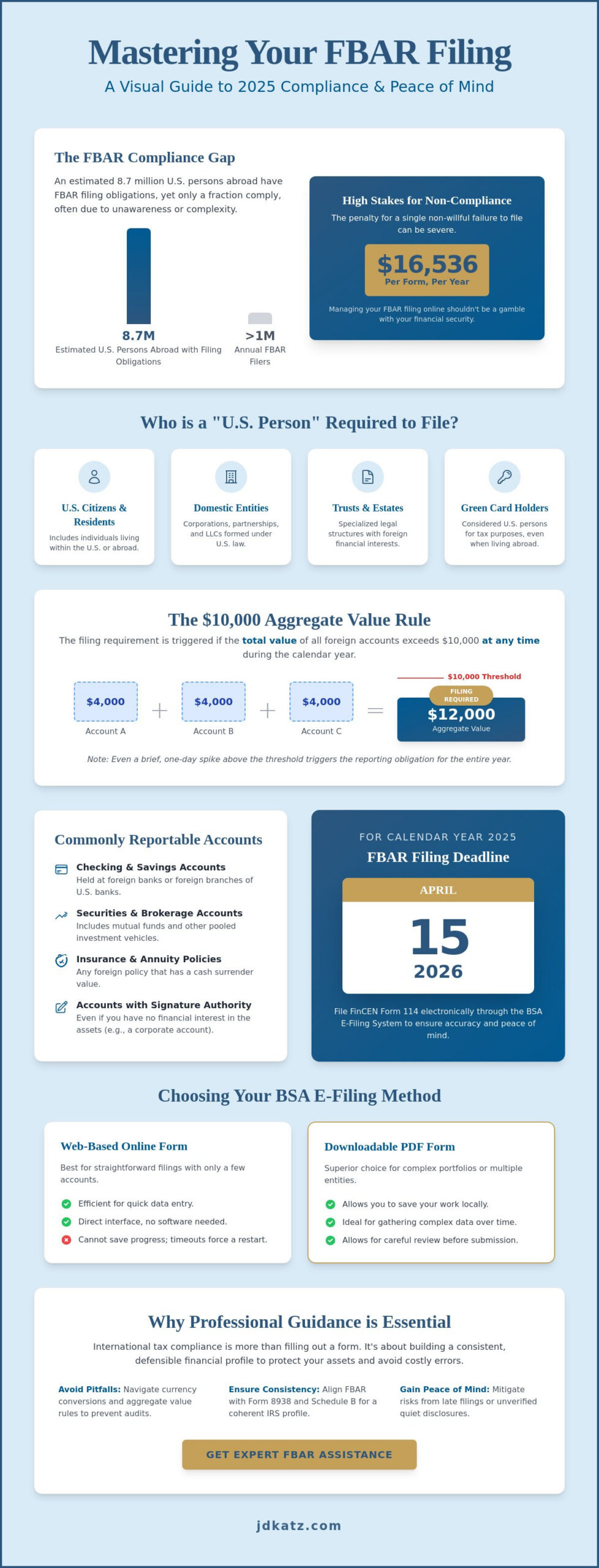
Did you know that while over a million Americans file their FBARs annually, this represents only a small fraction of the estimated 8.7 million U.S. persons living abroad who likely have reporting obligations? Many taxpayers find themselves paralyzed by the technical complexity of the BSA E-Filing system or the subtle distinctions between IRS and FinCEN requirements. If you’ve felt a sense of unease regarding your foreign accounts, it’s a valid concern; the penalty for a non-willful failure to file can now reach $16,536 per form. Managing your fbar filing online shouldn’t feel like a high-stakes gamble with your financial security.
We understand that maintaining international tax compliance requires more than just filling out a form. It demands a meticulous eye for detail and a proactive strategy. This guide will help you master the technical and legal requirements of the filing process to ensure total accuracy and peace of mind. You’ll learn how to navigate the aggregate value rule, handle currency conversions using the latest Treasury data, and avoid the common pitfalls that trigger audits. We’ll provide a clear, step-by-step roadmap for your 2025 calendar year submission, ensuring you meet the April 15, 2026, deadline with confidence.
Key Takeaways
- Identify whether you meet the filing threshold for FinCEN Form 114 as a U.S. person, including the specific reporting requirements for trusts and business entities.
- Master the technical steps of navigating the BSA E-Filing system to ensure your fbar filing online is submitted without technical errors or data mismatches.
- Learn to apply the aggregate value rule correctly by using the official Treasury Department exchange rates to calculate the highest daily balance of your foreign accounts.
- Understand the critical deadlines for the 2025 calendar year and the significant legal risks associated with late submissions or unverified quiet disclosures.
- Gain insight into aligning your foreign account reporting with Form 8938 and Schedule B to maintain a consistent and defensible profile before the IRS.
What is FBAR Filing Online and Who is Required to File?
Understanding your international reporting obligations starts with the Report of Foreign Bank and Financial Accounts, commonly known as the FBAR. While many taxpayers associate financial reporting exclusively with the IRS, this specific requirement is technically a FinCEN Form 114 filing. It’s submitted directly to the Financial Crimes Enforcement Network, which is a bureau of the Treasury Department. Although you file with FinCEN, the IRS maintains the authority to enforce compliance and assess penalties. This dual-agency involvement often creates confusion for taxpayers, yet the objective remains clear: the government seeks to identify assets held in foreign jurisdictions to prevent tax evasion and financial crimes.
The mandate to complete an fbar filing online extends to all U.S. persons. This definition is broader than many realize. It encompasses U.S. citizens and residents, but it also includes domestic entities such as partnerships, corporations, and limited liability companies. Specialized structures like estates and trusts must also comply if they hold foreign financial interests. If you’re a Green Card holder living abroad, you’re still considered a U.S. person for these purposes. Precision in identifying your status is the first step toward a secure and compliant financial strategy.
The $10,000 Threshold: The “Any Time” Rule
The filing requirement is triggered when the aggregate value of your foreign financial accounts exceeds $10,000. It’s vital to recognize that this is a cumulative total across all accounts. You don’t need $10,000 in a single account to trigger the rule. For example, if you hold three accounts with $4,000 each, your aggregate value is $12,000, and you must report all of them. Additionally, the “any time” provision is literal. If your balance briefly spiked above the threshold for a single day before being transferred, the reporting obligation remains. This rule applies regardless of whether the accounts generate interest or taxable income. Even a non-interest-bearing checking account counts toward your total aggregate value.
Common Foreign Accounts That Require Reporting
Identifying which accounts fall under the FinCEN umbrella is essential for a complete fbar filing online. The definition of a “financial account” is expansive and includes more than just standard bank holdings. To ensure meticulous compliance, you should review the following categories:
- Traditional checking and savings accounts held at foreign banks or foreign branches of U.S. institutions.
- Securities and brokerage accounts, including mutual funds and similar pooled investment vehicles.
- Foreign life insurance or annuity policies that possess a cash surrender value.
- Accounts for which you have signature authority, even if you don’t have a personal financial interest in the assets.
Properly categorizing these assets requires a thorough review of your global financial footprint. By identifying these accounts early, you can prepare the necessary documentation for a successful filing and mitigate the risk of future complications.
Step-by-Step Guide to FBAR Filing Online in 2026
Gathering your documentation is the essential first step toward a successful submission. For the 2025 calendar year, you’ll need to compile all foreign account statements that reflect the highest balance reached at any point during the year. Once you’ve organized this data, you’ll access the FinCEN BSA E-Filing System. This portal serves as the exclusive authorized channel for your fbar filing online. While the interface is designed for security, its technical requirements can be rigid, making preparation vital.
Web-Based Filing vs. PDF Filing: Which is Better?
The FinCEN portal offers two distinct paths: a web-based form or a downloadable PDF. For individuals with a straightforward financial footprint, such as one to three simple accounts, the web-based option is typically the most efficient. It provides a direct interface for quick data entry. However, this method doesn’t allow you to save your progress. If your connection times out or you need to verify a detail, you’ll have to restart the process from the beginning.
The PDF filing method is often the superior choice for those managing complex portfolios or multiple business entities. This version allows you to download the form, save your work locally, and collaborate with a professional advisor for a final review before submission. Regardless of the path you select, the system will generate a unique “Confirmation Number” once the filing is accepted. You should archive this number alongside your tax records for at least five years to provide definitive proof of timely compliance.
Required Information for FinCEN Form 114
Accuracy during data entry is non-negotiable. The Official IRS FBAR Information emphasizes that even minor omissions can lead to increased scrutiny. For every account included in your report, you’ll need to provide:
- The full legal name and physical address of the foreign financial institution.
- The specific account number or other unique designation.
- The maximum value the account reached during the 2025 calendar year, converted to U.S. dollars using the Treasury’s year-end exchange rate for December 31, 2025.
If you’re unsure about the specific account number or if an institution doesn’t use standard numbering, you must enter a descriptive placeholder rather than leaving the field blank. If the technical nuances of reporting multiple complex structures feel overwhelming, consulting a specialist in international tax law and FBAR disclosure can provide the necessary oversight to ensure your reporting is defensible.
The final stage is the digital signature. This acts as your legal attestation that the information provided is true and complete. Once you’ve signed and submitted the document, the system provides a downloadable copy of the completed form. Keeping this digital file in a secure, encrypted location is a best practice for long-term security. By following this methodical approach to your fbar filing online, you transform a complex regulatory hurdle into a structured, manageable task.
Calculating Aggregate Value and Currency Conversion
Precise calculation is the cornerstone of a defensible fbar filing online. To determine if you’ve met the reporting threshold, you must identify the highest daily balance for every individual foreign account held during the 2025 calendar year. This isn’t merely the balance on December 31; it’s the peak value reached at any point between January 1 and December 31. If you hold accounts in multiple currencies, you must determine the maximum value for each account in its local currency first, then convert those figures into U.S. dollars using the official year-end exchange rate.
A common mathematical trap involves the aggregation of these peak values. If you transferred $11,000 from a savings account to a checking account in July, both accounts will show a peak of $11,000 for the year. For the purposes of determining if you exceed the $10,000 threshold, the government requires you to add these maximum values together, resulting in an aggregate of $22,000. While this may feel like over-reporting your actual net worth, failing to follow this aggregation logic can lead to a missed filing and potential penalties. Following the IRS FBAR Filing Requirements ensures you don’t inadvertently omit accounts that technically trigger the mandate.
Signature Authority vs. Financial Interest
Reporting obligations aren’t limited to accounts you personally own. If you possess signature authority over a foreign account, such as a business account for an employer or a family trust, you may still be required to include it in your fbar filing online. The distinction lies in control rather than ownership. If you have the legal power to direct the disposition of funds through a signature or other comparable authority, the account must be disclosed. Employees of certain large, regulated entities may be exempt from reporting employer accounts, but this is a nuanced area where professional oversight is often necessary to avoid misclassification.
Official Exchange Rate Sources
To maintain consistency, the Treasury Department mandates the use of specific data sources for currency conversion. You should utilize the rates published by the Bureau of the Fiscal Service, now hosted at FiscalData.Treasury.gov. If a specific currency rate isn’t available through this portal, you may use other verifiable exchange rates, provided you document the source and use it consistently. All FBAR values must be expressed in U.S. dollars using the Treasury Reporting Rate of Exchange from the last day of the calendar year. For the 2025 reporting cycle, this is the rate effective on December 31, 2025. By adhering to these standardized values, you minimize the risk of mathematical discrepancies that could trigger an inquiry.
Navigating these complexities often requires the strategic foresight of a partner experienced in international tax law and FBAR disclosure. Managing multiple currencies and varying account types demands a methodical approach to ensure every figure matches your broader tax profile. When you treat these calculations with the necessary intellectual rigor, you protect yourself from the high costs of non-compliance.
What to Do if You Missed the FBAR Filing Deadline
Discovering that you’ve missed a regulatory deadline can be a source of significant anxiety, yet the path to resolution is structured and manageable. For the 2025 calendar year, the standard deadline for fbar filing online is April 15, 2026. If you miss this date, an automatic extension is granted until October 15, 2026. You don’t need to file a specific request for this extension; it’s applied to all filers by default. However, if you realize you’ve missed even this extended window, or if you’ve failed to file for several previous years, taking proactive steps is essential to mitigate financial exposure.
One of the most dangerous approaches a taxpayer can take is “quiet disclosure.” This involves simply filing the delinquent forms late without providing an explanation or participating in an official disclosure program. Treasury Department systems are designed to flag these late submissions, which often leads to increased scrutiny and the automatic assessment of penalties. Instead, the government provides specific compliance procedures designed for those who acted non-willfully. The Streamlined Filing Compliance Procedures offer a way for taxpayers to correct past errors while significantly limiting their penalty exposure. For those who correctly reported their foreign income on their tax returns but simply forgot the informational form, the Delinquent FBAR Submission Procedures may allow for a penalty-free resolution.
Penalties for Non-Compliance in 2026
The consequences of inaction are substantial, as penalties are adjusted annually for inflation. Following recent judicial clarifications, the penalty for a non-willful failure to file is now assessed at $16,536 per report. While this is a significant sum, it’s far less severe than the penalties for willful violations. A willful failure to file can result in a penalty that’s the greater of $165,353 or 50% of the total balance in the foreign accounts at the time of the violation. In extreme cases involving intentional tax evasion, criminal charges and imprisonment remain possibilities. This distinction between a simple mistake and a willful omission is the primary factor in determining your financial future.
The Role of a Tax Attorney in Delinquent Filings
Engaging a professional advocate is often the most prudent step when addressing past non-compliance. A primary advantage of working with a tax attorney is attorney-client privilege, which ensures that your disclosures regarding past errors remain confidential. This protection isn’t available when working with accountants or other financial advisors. A Bethesda tax lawyer can evaluate your specific situation, determine if your conduct meets the legal definition of “non-willful,” and draft a compelling “Statement of Facts” to accompany your late submission.
Strategic planning allows you to present your case in a way that emphasizes compliance and good faith. If you’re facing a potential audit or need to rectify years of missing forms, seeking experienced IRS tax audit representation can provide the security and foresight needed to navigate these complex transitions. By moving from a state of concern toward a structured professional solution, you can secure your assets and regain peace of mind.
Why Professional Guidance is Essential for International Tax
Successfully completing your fbar filing online is a significant milestone, but it shouldn’t be viewed in isolation. True financial security comes from ensuring this data aligns perfectly with your annual tax return. The IRS frequently cross-references FinCEN Form 114 with Form 1040, specifically Schedule B. Any discrepancy, such as checking “no” to the foreign account interest question on your tax return while simultaneously filing an FBAR, can trigger an immediate inquiry. This lack of consistency is a common red flag that leads to avoidable audits.
Global wealth often involves more than simple bank accounts. Many taxpayers hold interests in foreign pensions, complex wills and trusts, or Passive Foreign Investment Companies (PFICs). These assets carry unique reporting requirements that go far beyond a standard bank disclosure. PFICs, in particular, are subject to some of the most punitive tax regimes in the U.S. code. Managing these holdings requires a sophisticated, multi-disciplinary strategy to ensure that every figure reported to FinCEN matches the data provided to the IRS.
Coordinating FBAR with FATCA Reporting
While the FBAR is a FinCEN requirement, the Foreign Account Tax Compliance Act (FATCA) introduces Form 8938, which is filed directly with the IRS. The thresholds for Form 8938 are generally higher than the $10,000 FBAR limit and vary based on your filing status and whether you reside in the U.S. or abroad. It’s a common misconception that filing one form satisfies the requirement for the other. In reality, many taxpayers must file both. Failing to submit Form 8938 when required can lead to a $10,000 penalty and an indefinite extension of the statute of limitations for your entire tax return. A tax professional ensures that your fbar filing online is coordinated with your FATCA obligations to eliminate these gaps in compliance.
Strategic Planning for Bethesda Taxpayers
For high-net-worth individuals and business owners in Bethesda, international compliance involves managing Maryland-specific tax implications alongside federal mandates. Strategic planning isn’t just about the retrospective act of filing forms; it’s about proactive risk mitigation. By coordinating your global asset reporting with your broader estate and business goals, you create a comprehensive shield against future complications. Our team acts as a long-term partner, prioritizing thoroughness and calm guidance in an increasingly transparent global financial environment.
If you’re ready to secure your international holdings and ensure total compliance across all jurisdictions, schedule a consultation with our international tax attorneys at JDKatz. We provide the intellectual rigor and dedicated advocacy necessary to navigate complex transitions with confidence.
Achieving Long-Term Security in a Global Economy
Managing your international assets requires a methodical approach that extends beyond a simple form submission. By mastering the aggregate value rule and ensuring your data aligns with your broader tax profile, you protect yourself from the scrutiny of dual-agency enforcement. Completing your fbar filing online is a vital step in a larger strategy of risk mitigation and financial foresight. Precision today prevents the significant financial complications that arise from non-willful omissions or technical errors in the future.
With decades of experience in international tax law, our Bethesda-based experts provide the strategic defense necessary to navigate complex IRS tax audits and disclosure requirements. We act as dedicated advocates who prioritize the proactive minimization of future complications for high-net-worth individuals and business owners alike. Secure your international tax compliance with JDKatz to ensure your global transitions are handled with the intellectual rigor they deserve. You’ve worked hard to build your international wealth; we’re here to help you protect and maintain it with confidence.
Frequently Asked Questions
Is FBAR filing online mandatory for every year?
FBAR filing is mandatory for any year in which your aggregate foreign account value exceeds $10,000 at any time. If your assets fall below this threshold for a specific calendar year, you don’t have a filing requirement for that period. Because financial circumstances fluctuate, you should evaluate your accounts annually. This proactive review ensures you remain compliant as your global portfolio grows or changes over time.
What happens if I make a mistake on my FBAR filing online?
You must file an amended report if you discover an error after your initial submission. The process for an amended fbar filing online involves selecting the “Amended” box on the FinCEN Form 114 and providing the original confirmation number. Correcting mistakes promptly demonstrates a good-faith effort toward compliance. This transparency is vital if you need to explain discrepancies to the IRS during a future inquiry or audit.
Do I need to report a foreign pension on my FBAR?
Most foreign pension plans and retirement accounts require reporting on your FBAR. If the pension is held in a foreign financial institution or has a determinable cash value, it likely meets the definition of a financial account. Because the rules for various international retirement schemes are often intricate, reviewing the specific structure of your plan is essential. This ensures that your total aggregate value reflects all relevant global interests.
Can I file my FBAR jointly with my spouse?
Joint filing is permitted only under specific and narrow conditions. You and your spouse can file a single FBAR if all foreign accounts are either owned jointly or if one spouse has signature authority over the other’s accounts. If either spouse holds a separate account that isn’t joint, both must submit individual filings. Many couples find that filing separately is the most reliable way to ensure every individual interest is accurately disclosed.
What is the difference between FBAR and FATCA (Form 8938)?
FBAR and FATCA serve different regulatory purposes and have distinct reporting thresholds. The FBAR focuses on foreign bank and financial accounts exceeding an aggregate of $10,000. FATCA, or Form 8938, requires the disclosure of a broader range of foreign financial assets and typically applies only when those assets exceed $50,000. While their requirements overlap, you must evaluate each mandate independently to ensure you’ve satisfied both reporting obligations.
How long should I keep records of my FBAR filing online?
You must maintain records related to your fbar filing online for a minimum of five years from the date of the filing. These records should include the name on the account, the account number, the name and address of the foreign bank, and the maximum value reached during the year. Archiving your digital confirmation receipt and copies of your submitted forms is a fundamental step in your long-term risk mitigation strategy.
What do I do if my foreign bank doesn’t provide year-end statements?
If year-end statements are unavailable, you should use the most reliable records at your disposal to identify the highest daily balance. This might include monthly statements or digital transaction histories. You must document your efforts to obtain official data and maintain a record of the calculations used to determine the reported values. Consistency and a methodical approach are your best defenses if the Treasury Department requests verification of your figures.
Can a tax attorney file the FBAR on my behalf?
A tax attorney can file the FBAR on your behalf as an authorized third-party preparer. This arrangement requires you to sign FinCEN Form 114a, which provides the professional with the legal authority to transmit your data. Engaging an attorney for this process provides an added layer of technical oversight and legal protection. It ensures that your filing is integrated into a broader strategy for international tax law and FBAR disclosure.